Tuesday, April 23, 2013

Day 45 (Apr 19 2013): Phnom Penh

The Quick Facts:

* Spent ~1.5 days in Phnom Penh after arriving successfully from our exciting bus trip from Saigon
* Toured two main sites made infamous during the Khmer Rouge regime: the Tol Seng Genocide Center (“S21 Prison”) and the Choeung Ek Genocidal Center (the "Killing Fields")
* Also toured the National Museum, the Royal Palace, and the Russian Market
* Stayed at the One Up Banana Hotel, which is easily one of the nicest hotels we’ve stayed at in Asia (and for under $30/night!)

The Good:

* The S21 Prison and Killing Fields are powerful and moving, if not difficult to learn about and see
* Phnom Penh has beautiful architecture, and the people are for the most part very friendly (and their English is very good)

The Bad:

* People trying to sell you something or a tuk-tuk ride can be relentless – it is their way of making a living which I understand but sometimes it can be a bit frustrating


Unfortunately no trip to Phnom Penh can escape the stories and impact of the Khmer Rouge. During their brief reign from 1975-1979, in an effort to form a "utopian" agrarian collective state, the Khmer Rouge killed an estimated 2-3 million of their own citizens, which was approximately 25% of the population. The crimes worthy of death? Being educated (doctor, lawyer, professor, etc), living in a city, not supporting the Khmer Rouge in the "right" way, knowing the wrong people, etc. You get the idea. And it wasn’t enough to kill the men, entire families of condemned men (including children) were put to death in the most brutal and horrifying manners. The two sites dedicated to this period are the Tol Seng Genocide Museum (known as S21 back in the day) and the Choeung Ek Genocidal Center, known as the Killing Fields. Together they memorialize the brutal actions of some of history's truly evil men, while also act to preserve and honor the memories of all the victims.

 
Once arrested, prisoners were brought to S21 to be processed, interrogated, tortured, and detained. This is one of hundreds of similar prisons established throughout Cambodia. The structure is an old school, built before the rise of the Khmer Rouge and quickly outlawed as schools had no value in their extremist regime. Here are some pictures of the detention rooms...


As part of the exhibit, there are 30 or so of these types of boards, with the mug shots of each prisoner of S21.  Their faces are something I’ll never forget.


Once the prisoners were marked for death at the prison, they would be transferred to by bus to what is now known as the ‘killing fields’. There are some 300 known killing fields used by the Khmer Rouge in Cambodia. This particular site, some 15 km from the S21 prison, typically had a truck of 30 prisoners arrive every 2-3 weeks. Toward the end of the Khmer Rouge reign, trucks with 100 passengers would arrive every day. At this site alone, an estimated 20,000 people died--men, women, and children.

 
Here is the fence around a mass grave that has been exhumed and made into an exhibit.  Note all of the bracelets left by mourners.


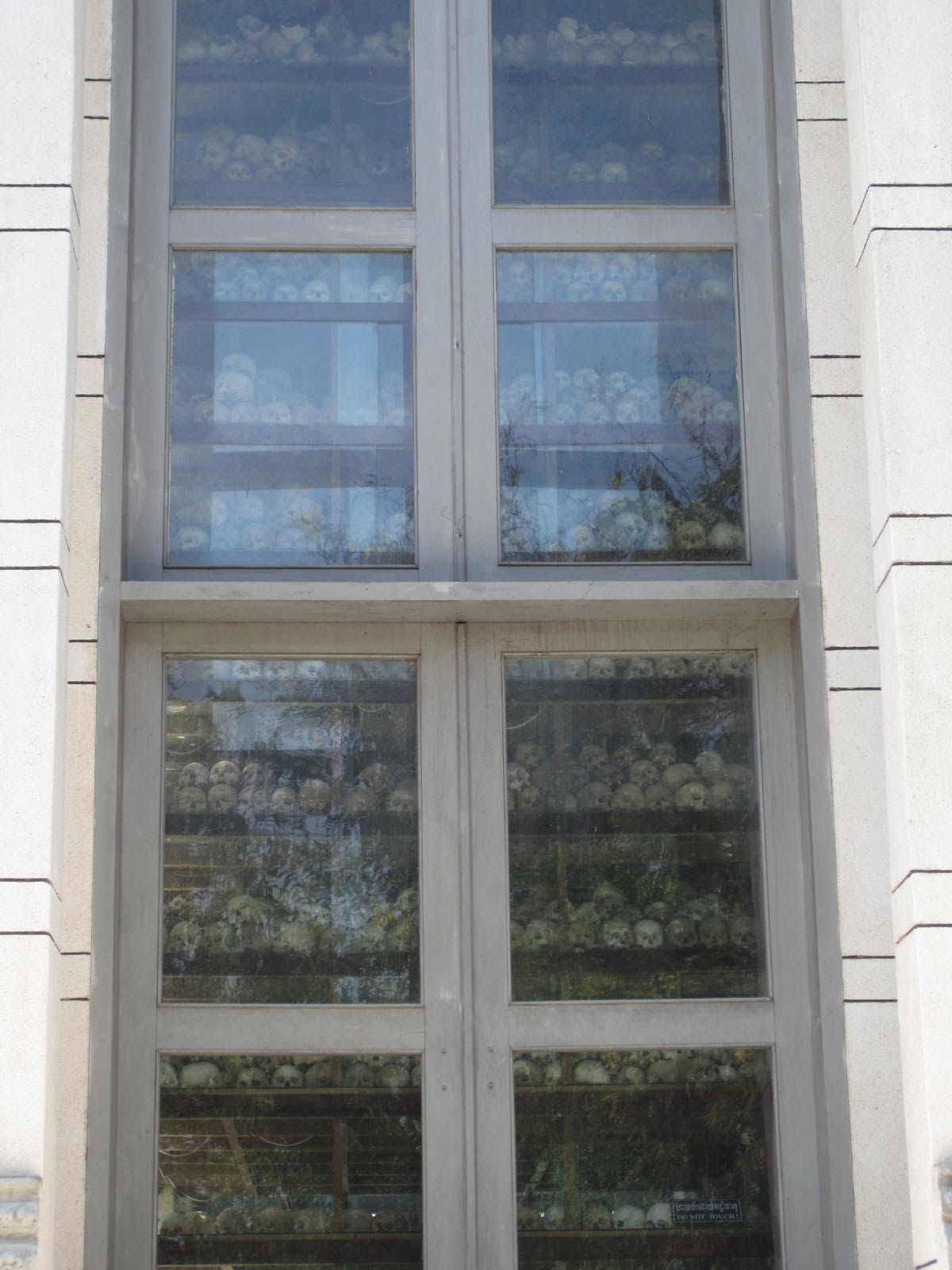
And in the middle of the center stands a stupa, containing the skulls and bones of the victims recovered in these fields.


Apart from these sites devoted to the atrocities of the Khmer Rouge, Phnom Penh is a beautiful city-- the architecture is beautiful, the streets are wide with a wonderful city center along the Tonle Sap river, and there aren't as many people as in the other Asian cities we’ve been to so it feels a little less crazy. Around town we went to the National Museum, which primarily houses very old Hindu statues:


And the royal palace--people are not allowed to enter the palace itself, but access to some of the buildings on the grounds is permitted.


As part of the palace, people are allowed into the silver pagoda, named because the floor is made of silver (which is of course all covered to protect it so you don't really get to enjoy it). Also, you are prohibited from taking pictures inside.


And, no trip to Phnom Penh would be complete without a walk along the river at sunset...


Follow me on Twitter at @adonaldson1214

Day 44 (Apr 18 2013): On Traveling in Southeast Asia: The Bus From Saigon to Phnom Penh

So our bus trip from Saigon to Phnom Penh turned out to be interesting.  The trip is supposed to be 5-6 hours, which includes getting out at the border crossing and also a ferry ride across a small river.  The beginning of the trip was easy enough – bus left on time and we got to the border.  Even the border crossing went OK, even though we were forced to surrender our passports and money to the bus tour guide while we waited in a big room with 300 other travelers, all trying at once to get through to the immigration officials.


Even that went OK.  Once through into Cambodia, we all settled into our bus seats thinking that everything was settled and the hard part of the trip was over.  Then, all of a sudden, our bus stops and we are told that we need to get off the bus, grab our bags, and start walking for “3 minutes” so we can catch the ferry.  This is unusual.  The traffic line to get to the ferry was so long, we had to walk…for about 1.5km (which, if you’re keeping score at home, is way more than 3 minutes, especially if you’re lugging around 20lbs of luggage!).  So, single file, we marched on a thin path in between idling cars spewing out untold amounts of exhaust on the left, and an endless amount of hawker stalls, beggars, and garbage on the right.


Eventually we make it to the Ferry, and ride the thing across the river.


Then we are told to march up the hill, and are funneled into a waiting area which doubles as a shack with a tin roof, where we all bombarded by people trying to sell us things (who, it should be said, are all endearing and we enjoy talking to them, but they are relentless).

 
Finally, the bus arrives, we get on, and make it to Phnom Penh.  Perhaps if they had just told us this was going to happen, even with 5 minutes’ notice (instead of 20 seconds), it wouldn’t have been so bad.


Follow me on Twitter at @adonaldson1214

Monday, April 22, 2013

Day 43 (Apr 17 2013): Ho Chi Minh City (aka Saigon) Part II

The Quick Facts:

* Day 2 was a walking tour of the city
* Visited the Jade Emperor Pagoda
* Visited the Reunification Palace, which was the home of the South Vietnamese President until the fall of Saigon in 1975; it is left virtually untouched from what it was back then and is decidedly 70s in every way!

The Good:

* The Reunification Palace is beautiful; your admission gets you a free tour guide which is super helpful and informative
* The food in Vietnam is delicious – it will come as no surprise but they knock their Pho out of the park
* The people are all very friendly
* Saigon has a lot of parks that are used by the people at all hours of the day – they make for a very pleasant walking experience

The Bad:

* The streets are packed with motorbikes (“motos”) that rarely follow the traffic laws (think not stopping at red lights, coming up onto the sidewalk, using the wrong side of the road) – it can be a bit harrowing trying to cross the street and you end up constantly thankful that you weren’t just hit by a car or moto


Today was spent walking around the city, first to the “old” part of the city used a lot by reporters and other ex-pats during the war (before the city fell in April 1975).  Three hotels (the Caravelle, the Rex, and the Hotel Continental), all across the street from each other, were the main spots to be especially for American journalists:


 And just up the street is a Catholic church…


And the post office, complete (now) with Ho Chi Minh’s smiling face as soon as you walk in…


Then we trekked up to the Jade Emperor Pagoda, which was recommended to us as one of the most powerful and beautiful pagodas in Saigon.  After a 30 minute walk there (it’s a tad out of the way), and the customary getting lost as the directions and map we were given bear no resemblance to reality, we finally came upon this:


Yeah, it’s a dump.  The grand pagoda took less than five minutes to walk through (and we took our time!), and looks like it hasn’t been repaired since the day it went up.

But at least we saw it, and it did enable us to witness a fairly hilarious shouting match between two Vietnamese women, arguing over territorial peddling rights in the courtyard of the pagoda.  No idea what they said, but their intonation and arm gestures will keep me going for a while.

After that, we went to what is now known as the Reunification Palace, which is the new (North Vietnamese) name for the Presidential Palace of the old President of South Vietnam.  Once a French palace, it was largely destroyed in the 50s due to war and eventually rebuilt, in full 60s/70s architectural grandeur.  Here it is:


And here is a replica of the North Vietnamese tank that stormed the gates in April 1975 to capture the palace and signify the fall of South Vietnam.


Next to finally (and completely unrelated), here is a quick picture of all the traffic you will undoubtedly hear me complain about at some point....


Finally, Dad, this is for you.  We tracked down Maxims, still alive and kicking after all these years.  We didn’t have time to eat there, but they did let us in to take a picture before the lunch crowd arrived…


Follow me on Twitter at @adonaldson1214

Day 42 (Apr 16 2013): Ho Chi Minh City (aka Saigon) Part I


The Quick Facts:

* Flew into Ho Chi Minh City on Monday night for two full days of touring in Saigon
* Visited the Cu Chi Tunnels, a series of underground tunnels used by the Viet Cong in their fight against the US during the Vietnam War
* Visited the War Remnants museum, which houses old US armed forces planes, tanks, etc, as well has four floors of pictures and items related to the war
* Stayed at the Bizu Hotel District 1 – a decent hotel, despite the postage stamp sized room, with an extremely friendly staff, a central location, and a very competitive price!

The Good:

* The Cu Chi tunnels were a must see, a really fascinating insight into how one aspect of the Vietnam War was fought on the ground
The Bad:

* The War Remnants Museum presents the North Vietnamese version of events – not surprising, but a little frustrating to read some of the propaganda

The last Donaldson to set foot in Vietnam was my father, in the early 1970s, as an officer in the US Army during what they call here the “American War”.  Forty years on, the country still remembers their fight for “reunification” but has very much succeeded in moving on: the trees and vegetation, once decimated by the use of Agent Orange and other defoliants, have all grown back; diplomatic ties with the US have been restored (since 1995); and the population distribution is skewed heavily to younger children who have no recollection of the war nor animosity toward US citizens – 43% of the population is under 24 years of age and only 13% is over age 55.  But this is not to say the war is forgotten – museums like the War Remnants museum and the Reunification Palace stand as reminders of the war and the South’s former independent status.  In the countryside, huge craters left by B-52 bombs still pepper the ground, a permanent part of the post-war landscape.  Also in certain rural areas active landmines still hide, waiting for an unknowing and innocent victim.

My first trip was the ~40 km (25 mile) ride northwest of Saigon to the Cu Chi tunnels.  The Cu Chi tunnels are a series of underground tunnels built by the local townspeople in the 1940s and 1950s and used by the Vietcong in their resistance against US-led forces during the Vietnam War.  The tunnels are tiny – sometimes only 40 cm wide – but have 3 levels (the first being 2-3m below the ground and the third 8-9m) and span a total of 250 km (150 miles).  The tour itself is well-run, even if it begins with a 10 minute anti-America propaganda film (see below), and succeeds in conveying the reality of the war in Vietnam: the dense jungle, never-ending rice paddies, the hot humid weather, and this network of tunnels that provided a serious competitive advantage to the enemy.  They all combine to show the difficulty, if not the impossibility, of the task laid out before our young men and women in the 60s and 70s.

But, as promised, here is a picture of the video room where they show you some anti-American propaganda:


And here is our tour guide, Billy Binh Tram (“Mr Bean”), who (if he is to be believed) says he trained US military to fight in the tunnels (the so-called “tunnel rats”) and spent 4 years carrying out missions with US forces in the area.


On to the tunnels, here is an entrance to one tunnel…


And that little hole is an air hole used so the VC could breathe while hiding in the tunnels…


Here is one of many booby-traps the VC set


And finally here are pictures from an actual tunnel during my 150m walk through one…it is *tight* in there, and I was glad to get out at the other end!


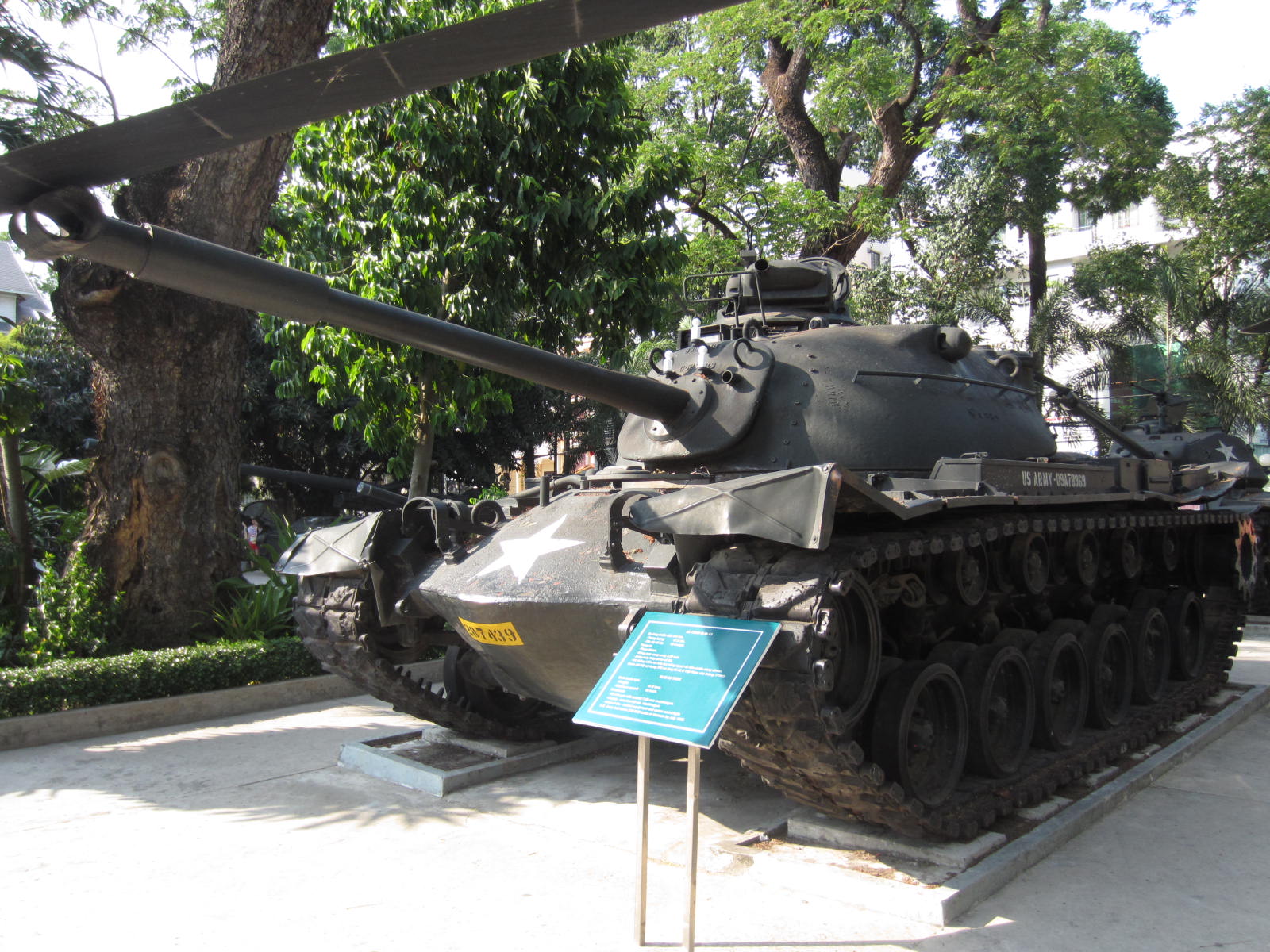
After the Cu Chi tunnels, I continued my day devoted to the war with a trip to the War Remnants Museum.  Inside, there are a bunch of photo exhibits about the war, all one sided depictions of certain events (some fair, some not), but outside there are a lot of old US military equipment that was left behind or captured as the south fell to the North Vietnamese army…


Leaving that all behind as best I could, we met up with our new Swedish friends Oscar and Annika (whom we met in New Zealand and are now also touring through SE Asia) for dinner, which was a lot of fun!


Follow me on Twitter at @adonaldson1214