Saturday, April 13, 2013

Day 33 (Apr 7 2013): Pura Bratan and Jatiluwih Rice Fields

The Quick Facts:

* After staying the night in Ubud at Kakiang Villas, Carrie and I hired a driver to take us to Pura Bratan (situated on Lake Bratan) and the rice paddies in Jatiluwih

The Good:
* The rice paddies in Jatiluwih, a 15km stretch of beautiful lush green, are a newly designated UNESCO (United Nations Education, Scientific, and Cultural Organization) site and worthy of the 2 hour drive to get there

The Bad:

* Pura Bratan is a bit touristy, and not as nice as some of the other temples we saw; I would say it wasn’t worth the trip, however it’s about 45 minutes from Jatiluwih so if you’re in the area…


The final part of our outdoor weekend was a drive through the Bali countryside, up to Lake Bratan to see the temple Pura Bratan and then over to the rice fields in Jatiluwih.  I didn’t like Pura Bratan that much, but here are a few pictures of the temple and the lake:


Ribbit…

 
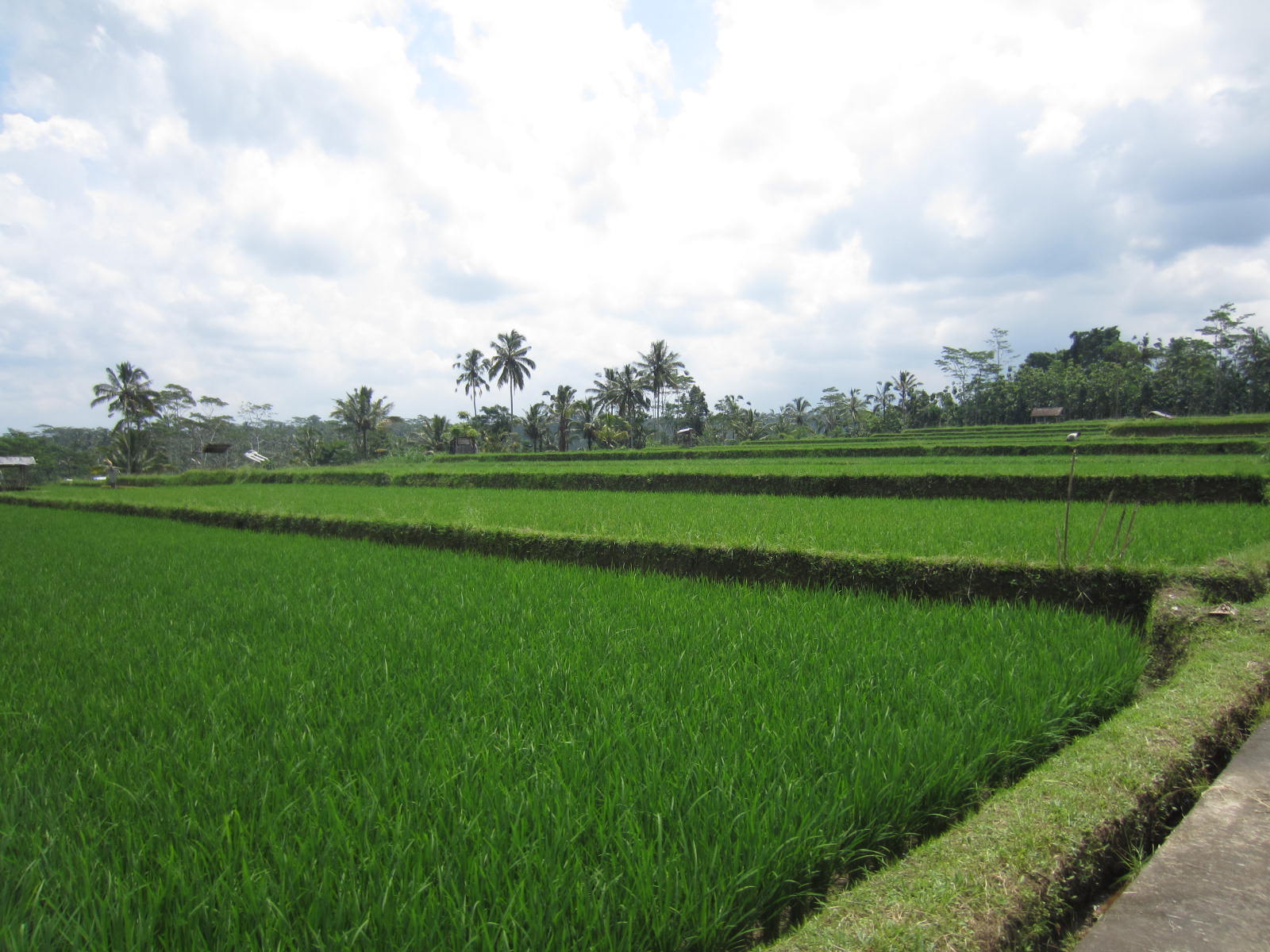
Jatuliwih was beautiful, the pictures speak for themselves:


And here is the view deep from within one of the rice paddies…it’s a little hard to tell, but hopefully this gives you some perspective as to a) how tall the rice plants are and b) the terraced nature of the landscape (which as I noted in a previous post is on purpose to help with irrigation)


Follow me on Twitter at @adonaldson1214

Saturday, April 6, 2013

Day 32 (Apr 6 2013): Sunrise Hike of Mt. Batur

The Quick Facts:

* Carrie and I continued our weekend of being outdoors with a sunrise hike of Gunung Batur (Mt Batur; elevation of 1717 meters) which is one of two active volcanoes in Bali
* Booked with Pineh Bali Tours who were great; Bali Sunrise Tours also a good operator
* After one month on the road, Carrie is still talking to me (I think)

The Good:
* The sunrise views at the top of Mt Batur were gorgeous
* Hard-boiling an egg with steam from a vent in the active volcano
* Our mountain guide, Wayan, who is a man of few words but somebody we grew to enjoy in a short amount of time


The Bad:
* Part of the deal, but you need to be up and out of the house at 1:30AM to make sunrise at the top of the mountain


This morning was dedicated to a sunrise hike of Ganung Batur (Mt Batur), which is one of two active volcanoes in Bali.  Here it is from breakfast during our bike tour:

 
The thing to do here is hike up the mountain in the dark (it’s a ~90 minute hike that is moderately difficult) to view sunrise from the top.  So, that’s what Carrie and I did.  Feeling completely refreshed after one hour’s sleep, Carrie and I awoke at ~1:15AM on Saturday morning to be picked up at our hotel by the tour company.  After a ~90 minute drive to the Batur region, we were treated to an excellent banana crepe and five different kinds of coffee and tea (our favorites: vanilla coffee and lemon tea).  Here we are at breakfast, looking our best:


After breakfast, we drove another 20 minutes to the car park before making our ascent.  We met Wayan, our guide who grew up in the region and has been leading people up the mountain for over 10 years, in the car park.  After arming our small group of three with flashlights (Elsa, from Taiwan, joined Carrie and me for the trek up) Wayan began leading us up the mountain at 3:50AM.  It was pitch dark, so I don’t have any pictures, but we arrived at the top at 5:15AM which allowed for a time series (of sorts) of the same shot (of Gunung Abang, 2153 meters and the third highest mountain in Bali) over the course of the sunrise:


And here is a picture of Carrie and me, along with Wayan and Elsa.

Here is a good picture of Mount Rinjani in Lombok (which is a ~90 minute boat ride away and the next island over from Bali in the Indonesian archipelago):

 
After sunrise, we ventured off to hike across the crater rim to a spot with a steam vent hot enough to boil an egg in 10 minutes.  Here is Wayan loading the eggs into the vent:


10 minutes later, ding!  Eggs are ready!  Delicious too!  After snacking on hard boiled eggs, banana, and bread, we decided to hike “the hard way” down the mountain to see this crater, which is the last crater formed on the mountain (in 2000) and is still steaming in a pretty significant way.


The climb down this way wasn’t for the faint of heart, but it did provide some of the most special pictures and experiences of the morning, so I highly recommend for those who are able and adventurous enough (young children, maybe less than 10, probably can’t handle it).  The walk along this crater includes a lot of steam and beautiful black sand.


Finally, the locals know that monkeys live in the mountain and can sense when an eruption is about to happen.  They know that when the monkeys descend the mountain in an unusual way, something is going to happen.  We went at a calm time, so the monkeys were all too happy to stop and pose for pictures.


Follow me on Twitter at @adonaldson1214

Day 31 (Apr 5 2013): Bali Bike Tour

The Quick Facts:

* No classes at the school on Fridays, so we went on a bike tour of Bali with Bali Eco Cycling
* Started with breakfast in Kintamani, then got a tour of some local plants and a special coffee drink (more on that later), then road ~35km south (mostly downhill) through rice paddies and small villages; ended with a delicious lunch

The Good:

* Bali Eco Cycling does a great job, this is a first rate tour operation in Bali, I highly recommend
* The tour we did was great for families and all ages (they even offer baby seats if you’re so inclined)

The Bad:

* Nothing really, very happy with how everything turned out


After a week of tutoring at the school, Carrie and I decided to spend our weekend outside.  We devoted Friday to a cycling tour run by Bali Eco Cycling, which I can’t say enough good things about.  The company designs everything with the guests in mind, and executes flawlessly.  If you are ever in Bali, I would highly recommend – it is good for old people like me and for families with children.

The tour began with a drive to Kintamani, a town on the perimeter of the Gunung Batur region (Mount Batur, an active volcano) and Lake Batur (Bali’s largest lake).  They arranged for breakfast at a hotel built into the hillside overlooking the mountain and lakes.  This is my view from breakfast, not bad eh?


After breakfast, they took us to a farm to give us a quick tour of some indigenous plants.  But the star of the show was this guy:


He is a Luwak (or, technically, an Asian Palm Civet).  Apparently, in Bali, they have a thing where this guy eats red coffee cherries found in the wild, digests the cherries and the coffee beans found inside, poops out the coffee beans almost intact (the Luwak’s digestive system alters the bean but does not break it down), at which point the pooped out beans are harvested, roasted, ground into coffee, and sold to people for ~$6.00/glass.  This is not a joke.  Here are the beans post-poop:


And being roasted:


And here is the marketing for it.  Perhaps it’s because I went to a “marketing” business school, but I think their campaign could be slightly revamped to something, you know, less revolting.


Needless to say, neither Carrie nor I plunked down the cash to try the liquefied poop, err, “coffee”.  If I am unable to find a job when I get back to the States, I am just going to start eating random things, pooping them out, turning them into another food and selling them to strangers for a ridiculous sum:  Customer: “What’s that odor?”  Me: “That’s the rich, bold flavor that makes this brownie cost $10/square.”

Moving on, we then started our bike tour which first took us through some rice paddies.  First, this was our guide, Kobe (seen here peering out from behind Carrie; yes, we see you!):

 
Here is a pic of rice terraces from far away.  They are all cascaded in levels down the slope so that gravity forces water to adequately flow and irrigate the rice paddies (which must be covered in water at all times).


 And here is a rice plant up close (notice how much water they are standing in):


And here are a few levels up close.  One tier of this paddy will yield 100kg (220 lbs) of rice.  This rice is genetically modified so that the seed-to-harvest cycle is 4 months, allowing a yield per tier of 300kg per year.  Organic rice (non-genetically modified) takes 6 months for one cycle.

 
After the rice paddies, we went to a traditional Balinese village – Sulahan – where we got a tour of a “compound” that consists of anywhere from 1 – 8 families and includes housing, a collective temple, kitchen, and other common areas.  It also included animal stalls, where we got an up-close interview with this lovely lady:

 
Oy, she’s got a face only a mother could love….


 After that we stopped for some bananas under this Banyan Tree, which is pretty cool lookin' (get a haircut you hippie!)


We then continued our ride through the Bali countryside, which was all downhill except for the last 8km which is on a gradual (and eminently doable) incline.  The tour company will let you ride in a van if you do not want to do the uphill part.

Follow me on Twitter at @adonaldson1214

Day 23 - 26 (Mar 28-31 2013): The Gili Islands

The Quick Facts:

* Spent the weekend in the Gili Islands (specifically Gili Trawangan)
* Took the fastboat (Marina Srikandi) from Padang Bai
* Stayed at Desa Dunia Beda
* Logged in plenty of beach time, and one snorkeling trip that took us to all three Gili Islands (Gili Trawangan, Gili Meno, and Gili Air)

The Good:

* Our hotel was perfect – remote from the 20-something party scene but close enough to everything
* I got in two runs during the weekend – I am still seriously out of shape though
* Snorkeling around the islands

The Bad:

* We stayed in Gili Trawangan; in retrospect, we should have stayed in Lombok and then did a day trip to the Gilis – Lombok is a big island with lots to do there, but transportation to/from the Gilis is limited and therefore makes doing anything worthwhile in Lombok quite difficult
* The boat transportation was fine because we were there in the offseason – during busier seasons, it is a bit confusing and I can see how some people complain of overcrowding (and therefore possibly dangerous situations)
Part II of our weekend refuge was a trip to the Gili Islands, which are three small islands off the northwest coast of Lombok.  To get there, you must take a boat (either a “fast boat” which gets you in there in 75 minutes or a “slow boat” which takes 3-4 hours) across the Lombok Strait from a port town called Padang Bai.  Here is the pier from which we left:

 
And here is our boat:


And here is the view from the cramped quarters inside (please no problems, please no problems, please no problems...)


 And here is a pretty good picture of Gunung Agung, the highest Balinese peak and believed to be the home of the spirits of Balinese ancestors.


Once we got to Gili Trawangan (or “Gili T” as it’s known), we quickly learned there are only three modes of transportation on the island.  You can use these:


Or these:


Or this:

 
Yep, no cars or motorbikes on the island whatsoever.  That last one is a “cedomo” which we had to use off the boat because our bags were heavy and our hotel was in a remote part of the island.  For those readers of this blog who know me well, you will know this was not a particular highlight for me.  I had to fight the urge to set all the horses free…

From there on out, it was relaxation time.  Here is the view from lunch we had on the beach (note the customary Andy Donaldson socks)…


And from our cabana on the beach near our hotel (note here that I have embraced my new, laid back self and taken off my socks.  Whoa)…


And from breakfast at our hotel…


OK, enough, you get the idea.  We also went snorkeling, which afforded some great views of the islands.  Here is one of Lombok:

 
And Gili Meno:


And Gili Air:


And here is a neat ship we saw anchored off the shore at Gili Air:


On Easter morning, Carrie and I got up to watch the sunrise:


Then we hiked up a small hill (the only hill) which gave some nice views of the island:


Finally, one thing to note about the Gilis is that there is very little fresh water on the islands.  There are no desalination plants on the islands (or at least not big ones, but this is starting to change), and it is expensive to have fresh water shipped in, so the showers, pools, etc are all salt water.  For fresh water, hotels typically have a separate barrel that is to be used sparingly.  Every time I looked at this thing, I kept looking around for Jeff Probst to tell me about the next Survivor challenge I’d be competing in.

Follow me on Twitter at @adonaldson1214